Showing posts with label Poland. Show all posts

Friday, May 15, 2026

POLAND ~ Church of the Blessed Virgin Mary - Haczow - UNESCO ~

... Nice view of a masterpiece of medieval, wooden Gothic architecture... the largest, oldest and best preserved wooden gothic church in Europe... a "wooden giant" standing on a small hill, characterized by its steep shingled roof and dark ancient wood... it survived almost unchanged for over 600 years and the logs that build it are made of wood some 800 years old today... surrounded by a historic wooden fence and a stone foundation... a must see for anyone interested in architecture, especially the traditional one... the unique interior atmosphere is noted as peaceful, quiet, and atmospheric... Thanks Kamilla!【ツ】

Photo: Pecold

Haczów is a village in southeastern Poland. The Church of the Assumption of the Blessed Virgin Mary and St. Michael the Archangel is situated on the Wisłok River in the Carpathian region. Built around the 1450s–1460s, it boasts a gothic south portal and a tall, distinct, steep-roofed structure designed to mimic brick Gothic buildings. The church contains unique 15th-century figural wall paintings (polychrome) from 1494, covering over 600 square meters. 

This is one of the six Wooden Churches of Southern Little Poland, on the UNESCO list of World Heritage Sites since 2003.
 
Stamps:

Definitives - Flowers and Fruits
(Issued 15-09-2015)

Postcrossing
(Issued 26-10-2024)

EUROPA Stamp 
(Issued 28-04-2025)

Saturday, November 15, 2025

POLAND ~ Muskauer Park - UNESCO ~

... Nice view of the new castle surrounded by an extensive English-style landscape park... Herman von Pückler’s park was designed to illustrate an ideal connection between nature, culture, technique and spirit... one of the most beautiful and largest landscaped gardens in Europe... the park straddles the border, with the Neisse River running through it and connecting the two countries... it is made up of a number of smaller parks on either side of the German-Polish border, each with its own character.... the New Castle in neo-Renaissance style is a central point in the park, and its grounds include a permanent exhibition about the life of Prince Pückler-Muskau... it is a popular destination to explore a large, beautifully designed natural space that spans two countries... Thanks Sylwia! (✿◠‿◠)

Photo: Tomasz

Muskauer Park  is a landscape garden initially developed between 1815 and 1844 by Prince Hermann von Pückler-Muskau on the grounds of his estate, and continued by his student, Eduard Petzold. The whole park consists of around 728 ha of which 522 belongs to Poland.

It is believed that there was a water castle until the 15th century when the complex was extended. In the 16th century, the property turned from medieval fortification to representative castle. Prince Pueckler planned to heavily redesign the castle, he removed fortress walls, bridges, and the moat. As money ran out, the new owner, Prince Wilhelm Friedrich Karl von Oranien-Nassau took over and rebuild the baroque castle in the neo-renaissance style.

In 2004, Muskau Park was added to the list of UNESCO World Heritage Sites.
 
Stamps:

Cities of Poland - Leszno 
(Issued 17-01-2020)

3X Marshals of the Second Polish Parliament 
(Issued 11-11-2020)

Spiżarnia Caritas
(Issued 15-03-2023)

Friday, October 10, 2025

POLAND ~ Zamość - UNESCO ~

... Great view of one of the most beautiful cities in Poland... famous for its perfectly preserved historic original urban layout from the Renaissance with blended Central European and Italian architecture... therefore also called “Pearl of Renaissance” especially thanks to the beautiful old town designed on a star plan... the city hosts over 200 historical monuments... the most memorable spot is the gorgeous old market square... absolutely stunning and colourful are the Armenian Tenement Houses... Zamość is not just about architecture but also rich cultural heritage... the city was a center of learning and culture, and the Zamojski Academy was one of the most important universities in Poland... an ideal destination for lovers of history and  architecture... Thanks Justyna!【ツ】

Zamość is located in the Far East of Poland near the border with Ukraine. The city was founded in the 16th century by the chancellor Jan Zamoysky on the trade route linking western and northern Europe with the Black Sea. Modelled on Italian theories of the 'ideal city' and built by the architect Bernando Morando, a native of Padua.

In 1992, the Zamość Old Town was added to the UNESCO World Heritage List 
 

Stamp:

Via Carpatia
(Issued 03-10-2018)
 
EUROPA Stamp   
(28-04-2025)

Poland See More
(Issued 27-06-2025)

Tuesday, September 16, 2025

POLAND ~ Rynek Główny - Krakow - UNESCO ~

... Great view of the historic, large medieval main square right in the heart of Kraków's Old Town... the square is surrounded by elegant townhouses and medieval buildings, offering a stunning visual experience... the city's historic center was remarkably well-preserved after World War II... home to significant landmarks like he Cloth Hall, Adam Mickiewicz Monument, Town Hall Tower, St. Mary's Basilica, and the Church of St. Adalbert are among them... Krakow is an incredibly charming city and thought to be one of the most beautiful cities in Poland... its blend of ancient history and vibrant, modern culture, making it a must-visit European city... Thanks a lot Gian Luca and Raffaella! (✿◠‿◠) 

Kraków is the second-largest and one of the oldest cities in Poland. Situated on the Vistula River in Lesser Poland Voivodeship, Kraków was the official capital of Poland until 1596 and has traditionally been one of the leading centres of Polish academic, cultural, and artistic life. 

Its Old Town became a UNESCO World Heritage Site in 1978. This was one of the very first places in the world to get this special status.
 
Stamps: 

Jerzy Iwanow-Szajnowicz, 1911-1943
(Issued 25-03-2021) 

The 150th Anniversary of the UPU
(Issued 30-10-2024)

Saturday, September 6, 2025

POLAND ~ Lady with an Ermine - Czartoryski Museum - Kraków ~

... Beautiful view of one of the greatest and most famous portraits in the history of art... it is in fact the central masterpiece of the Museum’s collection that captures the essence of Renaissance artistry.... the work is one of only four female portraits painted by Da Vinci... the painting is known for its naturalistic depiction of Cecilia and the ermine she cradles, which was the Sforza family's heraldic animal...  she was the favourite and most celebrated of the many mistresses of Ludovico Sforza, known as Duke of Milan, patron of Leonardo da Vinci... renowned not only for her beauty, but for her wit, her pursuit of the arts and scholarship...  Thanks a lot Gian Luca and Raffaella! (✿◠‿◠)


Leonardo da Vinci, Lady with an Ermine, 1489-1491, painted in oils on a panel of walnut wood.

The young woman in the portrait is Cecilia Gallerani (1473-1536). She came from a respectable background, even though she was not a member of the nobility. Her family was from Siena, where she was born sometime around 1473.

The painting was brought to Poland from Italy by Prince Czartoryski in 1798.  It was moved to Dresden for safekeeping during World War I and was looted by the Nazis during World War II before being returned to Poland.  The Polish government purchased the painting in 2016, and it is now displayed in the Czartoryski Museum.


Stamps:

The 150th Anniversary of the UPU 
(Issued 30-10-2024)
 

Jerzy Iwanow-Szajnowicz, 1911-1943
(Issued 25-03-2021)

Saturday, August 30, 2025

POLAND ~ Gorce National Park ~

... Lovely nature view of a forest-covered area in the Carpathian Mountains with many over 100 years old trees.... created  to protect the beauty of landscape and wildlife in Gorce Mountains... known for its lush forests, rolling hills, and crystal-clear lakes... making it an ideal destination for outdoor enthusiasts... visitors can explore well-marked trails that wind through dense woodlands and glades which offer magnificent panoramic views to the nearby mountain ranges of the Tatra, Pieniny and Beskidy Mountains from various lookout points... since its designation the Gorce National Park has adopted the fire salamander as its emblem, representing the only native salamander in Poland... (shown on the postcard👍) Thanks a lot Daria!【ツ】

  
Gorce National Park was established in 1981 and covers the area of 7019 ha; the main element of the landscape are forests taking 95%. It is a typical forest mountain Park, with a layer configuration of plants (lower and upper prealps). It comprises the central part of the Gorce with 5 summits of over 1200 meters. In the slopes of Turbacz (1310 meters above sea level) rise 10 streams, with “the queen of the Gorce rivers” – the Kamienica. The oldest man-made monument is Bulandy Chapel at Jaworzyna Kamieniecka Glade. 
 
Stamps:

2X Beneficial Insects
(Issued 30-04-2021)

The Eastern Carpathians of Poland
(Issued 23-05-2021)

Thursday, July 31, 2025

POLAND ~Ojców National Park ~

... Many nice views of Poland's smallest National Park... it’s a stunning mix of architecture, rock formations, caves, castles, and the picturesque Prądnik Valley... a characteristic element of the landscape are numerous limestone rock formations of fabulous shapes... the sunlit rocks are not only pretty, but also provide a home for many rare plants and animals... the underground world of Ojców and its vicinity is equally valuable and requires protection as well... there are about 700 caves which provide shelter for a  thriving bat population, with 17 out of Poland’s 25 bat species... the Jurassic landscape of Ojcow National Park is a haven for outdoor activities... it is an oasis for climbers, and a paradise for archaeologists exploring caves... Thanks Karolina!【ツ】
Photo: D. Kmiotek, M. Habinka, R.Cieślik

COjców National Park (ONP) was established in 1956. It covers the charming Prądnik Valley, one of the so-called Podkrakowskie Valleys, in the southern part of the Kraków-Częstochowa Upland.  It takes its name from the village of Ojców, where it also has its headquarters. 

Initially, it covered 14.40 km², but it has since been expanded to 21.46 km². Of the total area, 15.28 km² is forested, and 2.51 km² is designated as strictly protected.

Stamps:

The 200th Anniversary of the Botanical Garden of the University of Warsaw
(Issued 10-09-2018)

EUROPA Stamp
(Issued 21-04-2022)

Lighthouses 
(Issued 19-06-2015)

Tuesday, May 21, 2024

POLAND ~ Centennial Hall - Wroclaw - UNESCO ~

... Great view of one of the main landmarks and symbol of the city... a pearl of modernism located in a nice, green area near the zoo... with  the multimedia fountain next to it... when it was built it was the most impressive reinforced concrete structure in te world... and certainly a pioneering work of modern engineering and architecture... the dome is 42m high and 65m in diameter... after over hundred years, the Centennial Hall is still the most important place in Wroclaw hosting many cultural and sport events... while after the war the hall was renamed into People's hall (Hala Ludowa), today the original German name is used again... the only reason this beautiful building survived the war is that it served as an excellent orientation point for airstrikes... with nice selection stamps used.... thanks a lot Joanna!ヽ(•‿•)ノ 

Photo:Patryk Michalski

The Hall was built in 1911-1913 to the plans of Max Berg to commemorate the 100th anniversary of victory over Napoleon in the Liberation Wars of 1813-15.

Following the renovation in 2009–11, the arena can now hold 10,000 people. In 2014, the building received a $200,000 renovation grant from the Getty Foundation, as part of the Keeping It Modern grant program that was created a month earlier by the American foundation.

In 2006 UNESCO added it to the list of World Heritage buildings as one of the most important achievements of the twentieth century architecture.

Stamps:

Sunflower
(Issued 26-06-2015)

Insects - Butterflies
(21-02-2024)  

Birds of Polish Parks 
(Issued 16-02-2024)

Volleyball Men's World Championship Gold Medals 
(Issued 28-12-2018)

Flowers & Fruits
(Issued 02-07-2016)

Monday, March 25, 2024

POLAND ~ St. Michael the Archangel Church - Binarowa -UNESCO ~

... Nice view of  one of the oldest and most valuable monuments of wooden religious architecture in Poland... from the outside you see a wooden fence, wooden little chapel and main wooden building.... when you enter, you are in a picturesque world of colors, figures and decorations which makes an enormous impression on visitors... they were designed to bring the Bible closer to people, and were an interpretation of the rules of conduct... angels in Binar's church are everywhere, thanks to them the church is simply magical... Thanks a lot Anastasiia!ヽ(•‿•)ノ

Photo: Andrzej

Michael Archangel's Church is a Roman Catholic Gothic-wooden church located in southeast Poland, dating built around 1500, enlarged in the 16th and 17th centuries (tower, chapel, porch). In the 1990s, the church was restored to its original structure, with the roof tin replaced with wood shingle. Between 2010 and 2012, the church was renovated, restoring the church after damage made in the 2010 flood.

This is one of the six Wooden Churches of Southern Little Poland, on the UNESCO list of World Heritage Sites since 2003.


 Stamp:

The 30th Anniversary of Caritas Poland 
(06-10-2021)

Monday, September 12, 2022

POLAND ~ Historic Silver Mine - Tarnowskie Góry - UNESCO ~

... Interesting view of the Tarnowskie Góry Lead-Silver-Zinc Mine and its Underground Water Management System... a historic mining landscape with mostly underground parts... the mine is not just about the silver, lead and zinc, but it is also about how the water management system is used and evolved... today it is a unique tourist attraction in Poland that allows visitors to explore the underground labyrinth of the former silver-ore mines... and where you will feel the atmosphere of the former mining work... find out with what methods they extracted the treasures that nature left them...  but visitors can see only a small part of the extensive labyrinth of corridors... the underground sites are not only tourist attractions... the tunnels at Kowary have been adapted as an inhalation centre for Radon therapy... the salt mine in Bochnia has a restaurant, a basketball court and a chapel where weddings are held regularly... the Staszic Chamber at Wieliczka is used by balloonists... the cellars beneath the Market Square in Krakow have been taken over by restaurateurs... Thanks a lot Kamila!ヽ(ヅ)ノ  

Located in Silesia region of Poland, Tarnowskie Góry was once one of the main mining areas in Central Europe. Since the lead-ores available in the region contain a considerable admixture of silver, the region grew quickly and was of great strategic importance. In 1526, Duke of Opole John II granted Tarnowskie Góry the status of an independent mining town. The mining activity continued until 1912 when the extraction stopped due to resource shortage.

Tarnowskie Gory Lead-Silver-Zinc Mine and its Underground Water Management System was added to the UNESCO WHS list in 2017.


Stamp: 

Jerzy Iwanow-Szajnowicz, 1911-1943
(Issued 25-03-2021)

Friday, July 1, 2022

POLAND ~ Kalwaria Zebrzydowska - UNESCO ~

... Beautiful aerial view of one of Poland's oldest, most famous and important religious sites... Kalwaria Zebrzydowska is a landscape park and pilgrimage site with many chapels, churches, bridges and houses that are kind of replicas of those in Jerusalem... located close to the birthplace of Saint John Paul II (Wadowice)... in a picturesque setting between two mountain ranges... surrounded by beautiful nature, hills field and woods... over a million pilgrims visit this devotional complex every year... today its famous for its Eastern Passion Plays... there is marked a path in the mountain, where you can follow the different stages of the calvary... a serene and peaceful area...Thanks a lot Monika!(✿◠‿◠)

Kalwaria Zebrzydowska is a small town in in southern Poland close to Krakow. 

The layout was designed by Feliks Zebrowski in 1604. It intended to represent the landscape of Jerusalem at the time of Christ. It's an example of a so-called Calvary (a man-made landscape symbolizing the stages that led up to Christ's crucifixion), of which many were built in Europe in the 17th C. 

The site includes a total of 44 buildings, among them many diverse chapels. It was named after its founder, Mikolaj Zebrzydowski, at the time governor of Krakow. The distances between the chapels here are longer than in Jerusalem itself, but within the same proportions.

 In 1999 the whole complex has been inscribed onto Unesco's World Heritage List.

Stamps

Flowers & Fruits 
(issued 06-07-2016)

Flora - Polish Clematis 
(Issued 25-06-2019)

EUROPA Stamps - Stories and Myths 
(Issued 21-04-2022)

Wednesday, February 23, 2022

POLAND ~ The Church of Peace - Jawor - UNESCO ~

... Lovely view of church nr 2 of this UNESCO site... another architectural gem... one of two that still remains from the three that the Treaty of Westphalia allowed Protestants to build... they are the largest timber-framed religious buildings in Europe and a symbol of religious tolerance from the 17thC... built entirely without stone and yet on the inside it's as big as a medieval opera house... Jawor's baroque interior with four rows of galleries with balustrades richly ornamented with Biblical scenes and blue and white decorations are quite unique... the churches were very much neglected during the communist regime... today, they are beautifully restored by the joint efforts of Germans and Poles... Thanks Rafal!【ツ】

The church of Jawor is located in southwestern Poland, in the Lower Silesian region in the town of Jawor and was built betweeen 1654 and 1655 according to a design by the Wroclaw architect Albrecht von Saebisch.

The name "Churches of Peace" refers to the end of the Peace of Westphalia in the year 1648, which marks a century long war between Catholics and Lutherans. The churches were built after the Peace of Westphalia, when the Lutheran Protestants were allowed by German emperor to built their churches.

In 2001, the two similar churches in the towns called Swidnica and Jaworboth were listed as a UNESCO WHS site.

 Stamps:

2X Treasures of the Earth 
(Issued 02-12-2021)

Thursday, January 20, 2022

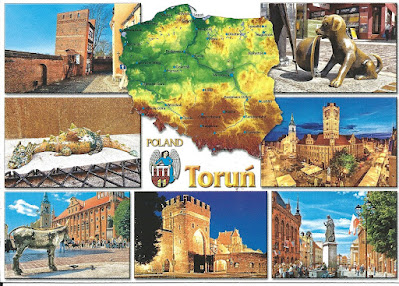
POLAND ~ Torun - UNESCO ~

... Lovely views of a beautiful small medieval and well-preserved trading town along the Vistula river... one of the oldest cities in Poland... because Torun and its many architectural treasures escaped destruction during the World Wars nothing had to be rebuilt in the aftermath of these terrible events... that's why you’ll be seeing some of the country’s best medieval buildings.... it is the birthplace (1473) of the astronomer Nicolaus Copernicus (Mikołaj Kopernik) and the seat of Nicolaus Copernicus University, as well as several scientific societies, museums, and theaters...Thanks a lot Kamilla!【ツ】

Toruń is a city in north-central Poland. The city was founded in 1233 and originally located by a crossing on the Vistula River  in Old Torun. There, the Teutons built their first settlement in the Land of Chełmno - according to a legend - on a mighty oak, and then located a town, which was soon relocated to its present site in 1236  due to recurrent floods.

In 1997, the Old Town Complex was included in the UNESCO World Heritage List and consists of three parts: the Old Town, the New Town and the Castle of the Teutonic Order. 

 Stamps:

Forest Fruits 1968
(Issued 17-03-1977)

Fairy Tales 
(Issued 15-03-1968)

Monday, September 20, 2021

POLAND ~ Krzemionki Prehistoric Striped Flint Mining Region - UNESCO ~

... Great new UNESCO site... covering an area of about 80 hectares makes it the largest and one of the most important prehistoric mines of banded flint in Europe... the mine has a 500m long underground route... visits to the mines offer a step back in time where visitors can learn about prehistoric settlements, cultural traditions and the importance of flint mining for the area and human evolution... you can go inside the mines, which have been excavated to allow walks through the mine and view protected areas through windows... the museum houses relics discovered in the excavations, as well as model examples of how the miners may have lived... now you can buy beautiful jewellery made of it... Thanks Sebastian!【ツ】

The Krzemionki prehistoric striped flint mining region is a group of 4 mining sites dating back to from the Neolithic to the Bronze Age (ca. 3900 to 1600 BCE) located in the mountain region of Świętokrzyskie, 

There are more than 4000 mine shafts known with depths of 9 meters deep with wells measuring from four to twelve metres in diameter. The flint excavated from the mines was shaped into items similar to axe heads, chisels and other tools. These products were then traded and as a result were distributed to all parts of Central Europe.  

The Krzemionki mines were discovered by Prof. Jan Samsonowicz, a Polish geologist, in 1922.

In 2019, the ancient mine was added to the list of UNESCO World Heritage Sites.

Stamp:

Jerzy Iwanow-Szajnowicz, 1911-1943
(Issued 25-03-2021)

Wednesday, July 15, 2020

POLAND ~ The Church of Peace - Swidnica - UNESCO ~

... Lovely view of an architectural gem and one of the most beautiful churches in Poland...  an impressively large timber-framed structure... the exterior is rather plain with hardly any decorative elements, only little is reminiscent of a church... the reason for this is that the Emperor Constantine, imposed many restrictions on the Peace Churches... in fact, they were supposed to be built "in a shape that is not typical for churches"... it has a total area of 1,090 m2 (covering the ground floor and 4 levels of balconies) and capable of housing 7500 persons of which 3000 seated... the 17thC baroque interior is richly decorated and beautiful.......it has numerous wonderful paintings and frescoes that are one of a kind, and they make this church very unique... Thanks a lot Kamilla!【ツ】
The Church of Swidnica is located in Southern Poland built by architect Albert von Sabisch and by professional carpenters called Andreas Gamper and Kaspar Konig from 1656 to 1657.

The name "Churches of Peace" refers to the end of the Peace of Westphalia in the year 1648, which marks a century long war between Catholics and Lutherans. The churches were built after the Peace of Westphalia, when the Lutheran Protestants were allowed by German emperor to built their churches.

In 2001, the two similar churches in the towns called Swidnica and Jaworboth were listed as a UNESCO WHS site.


Stamp:

EUROPA Stamps - Bridges
(Issued 02-05-2018)

Tuesday, October 8, 2019

POLAND ~ Lady with an Ermine - Lenonardo da Vinci - Krakow ~

And finally my last great postcard coming from Krakow💙... few people know that in this city is a well known Leonardo da Vinci painting... a beautiful and important painting because it is one of the only four women’s portraits painted by him.... the first renaissance painting of a woman that shows her personality and mind, not only her beauty... in excellent condition despite the passage of over 500 years... according to some art historians, it is the first portrait of modern-ages in the world... from 2017 this magnificent painting is housed in the Main Building of the National Museum... Thanks so much dear Dustin for taking me with you on your trip in Krakow through wonderful postcards! (✿ ♥‿♥)

Lady with an Ermine (Portrait of Cecilia Gallerani) was painted between 1489 and 1490. The subject of the portrait is Cecilia Gallerani, the mistress of Ludovico Sforza, Duke of Milan. Leonardo was in the service of the Duke at the time the portrait was painted.

The finished oil-on-wood painting, which is owned by the Czartoryski Foundation in Poland, shows the woman holding a light-colored ermine in her arms.The ermine was a symbol of purity for Leonardo

The Lady With An Ermine' came into Polish hands in 1800, after it was bought by the young Prince Adam Czartoryski (later a hero in the fight for Polish independence) during his tour of Italy. The painting was for his mother, a keen collector and the foundress of the Czartoryski Museum.

Stamps:

Never Again
(Issued 27-01-2018)

Defence War 1939
(Issued 27-08-2009)

The 15th Anniversary of Poland's Accession to the European Union
(Issued 01-05-2019)


Monday, October 7, 2019

POLAND ~ Jagiellonian University - Krakow - UNESCO ~

... Great view of the courtyard "Collegium Maius" one of the oldest buildings of the university... and one of the oldest in the city... it is an attractive example of Gothic style architecture with an inner courtyard surrounded by a series of arches made of brick and stone... today, Collegium Maius houses the Jagiellonian University Museum... with an extensive collection of historic instruments once used for astronomy, meteorology, cartography, physics and chemistry... one of the highlights of the Collegium Maius is its courtyard clock... the clock performs every two hours, when a parade of wooden figures depicting the most important people associated with the university come alive to a pleasant tune... one of the university's most famous students is Nicolaus Copernicus... and also Pope John Paul II studied here... Thanks a lot Dustin!✿◕ ‿ ◕✿
The Kraków University was founded on 12 May 1364 by the Polish king Casimir the Great. Following the failed attempts to restore it in the 1390s, the University was re-founded by King Vladislaus Jagiełło on 26 July 1400.

Queen Jadwiga, who died in 1399, contributed to the restoration by leaving a considerable portion of her private estate to the University in her last will. The University's structure was already complete in 1397, with the formal establishment of the faculty of theology. The oldest, main college was at first called the Royal Jagiellonian College (Collegium Regium), and then the Greater College (Collegium Maius).

The university consists of fifteen faculties, including the humanities, law, the natural and social sciences, and medicine. The university employs roughly 4,000 academics, and has more than 40,000 students who study in some 80 disciplines

Stamps:

The 80th Anniversary of the Defense of the Polish Post in Gdańsk
(Issued 01-09-2019)

The 80th Anniversary of the Start of World War II
(Issued 01-09-2019)

Friday, October 4, 2019

POLAND ~ Market Square - Krakow - UNESCO ~

... Lovely Krakow view nr 2... right in the heart of the old town is the main square, popularly known as the Rynek Glowny... one the largest medieval market squares in Europe... it  has an important historical, cultural and social significance... dominated by the Renaissance-style Cloth Hall and flanked by colorful neoclassical buildings, the square is both an architectural landmark and the main hub of local life... you can enjoy a cup of coffee in one of the many restaurant terraces... listen to a traditional bugle call that can be heard every hour from the tower of St. Mary’s Basilica... and visit the oldest “supermarket” of Poland... with great matching "Krakow" stamp... Thank you Dustin!!ヽ(ヅ)ノ
The huge main square was staked out for the city when Kraków received its city charter based on Magdeburg Law in 1257. It was set up at the intersection of ancient trading routes, on the plan of a square, with each side slightly exceeding 200 m.

The name Rynek (Market Square), deriving from the German word Ring, was first used around 1300, and the current one – Rynek Główny (Main Market Square)– has only been in use since the end of the 19thC.

Krakow Old Town was acclaimed by UNESCO as a World Heritage Site in 1978.

Stamps:

Krakow - Capital of European Culture
(Issued 26-04-2000)

EUROPE - National birds
(Issued 24-04- 2019)

Thursday, October 3, 2019

POLAND ~ Wawel Cathedral - Krakow - UNESCO ~

... First of 4 great Polish postcards👍... and indeed my first ever from "Krakow"😉... this one shows Poland's most important national sanctuary... the cathedral attached to Poland's royal castle is huge and impressive, especially the tombs are fantastic... it holds a special place in the history of the Polish State due to the fact that it was the church of Polish kings for 400 years... the most important state ceremonies: coronations, weddings, baptisms and funeral ceremonies of Polish royalty were celebrated at Wawel Cathedral’s High Altar... a special place in the Pantheon of Kracow bishops is due to Cardinal Karol Wojtyła, who was raised to the highest Church dignity and became the spiritual father of the entire world as Pope John Paul II...  In 2008 his monument was built, facing the entrance to Wawel Cathedral... with wonderful  minisheet depicting Pope Francis❤️...   Big Thanks Dustin!!【ツ】

"We are all well aware that to enter this Cathedral can not be without emotion. More I say, you can not enter it without the internal tremor, without fear because it contains in it – as in almost no Cathedral of the world – the enormous size, which speaks to us in all our history, our entire past." ________________________________________
Kardynał Karol Wojtyła 8 March 1964
Krakow is located in the south east of Poland founded in 1257 and has always been one of Poland's most important cities and important cultural and educational centers. Until 1609 Kracow was the Polish capital, when it was moved to the more central Warsaw.

The Wawel Cathedral ( Katedra Wawelska), is a Roman Catholic church located atop of Wawel Hill. The building you see is the third church on this site, consecrated in 1364. The present-day cathedral  is basically a Gothic structure but chapels in different styles were built around it later.

In 1978 the entire old town was named UNESCO site.


Stamp:

World Youth Day  - Joint Issue with Vatican City
(Issued 10-05-2016)

Wednesday, August 14, 2019

POLAND ~ Gdansk - UNESCO (Tentative) ~

... Many lovely views of one of Poland's prettiest seaside cities... a city with rich heritage and history... the historic centre of the city is a beautiful place with some stunning architecture that’s heavily influenced by Germanic and Polish tradition... and political history... Gdansk was a witness of events which shaped not only the history of Poland but also the whole world.... this city is considered to be a symbolic place of Second World War outbreak... in Gdansk Polish workers created Solidarity - first independent anti-Soviet labor union... a major and very popular tourist attraction for both Polish citizens and foreigners... Thanks a lot Sylwia! ❀◕ ‿ ◕❀
Gdansk is located in the northernmost point of the country. A city on the Baltic coast, it is the main port of Poland and the capital and largest city of the Pomeranian Voivodeship.

Founded in 997, the city's name is thought to originate from the Gdania River. It has been known by many names through its history which dating back 100s of years. Danzig, Kdanzk, Danczig, Gyddanyzc, Danzc, Danczk, Gdąnsk, Gdania, Danceke, Danczik and Gdanzc.


Stamp:

Polish Cities - Białystok
(Issued 19-02-2019)