Showing posts with label Australia. Show all posts

Monday, June 1, 2026

AUSTRALIA ~ Murujuga Cultural Landscape - UNESCO ~

... Great view featuring one of the world’s oldest and densest known rock art collection... it's not an extremely large area, but it's packed with an estimated of one million petroglyphs etched across the region’s ancient cliff faces... what's truly amazing about Murujuga is the incredible variety of petroglyphs, in both age and subject matter: the oldest petroglyphs here have been dated at around 40,000 years old, while some are as recent as the 19th century... especially notable are the depictions of human figures; they continue to be part of the traditions and beliefs of the Ngurra-ra Ngarl... also the sheer number of animal petroglyphs provide a fascinating showcase of how the local fauna has changed over the millennia... there is a very clear petroglyph of a thylacine (aka Tasmanian Tiger), which has been extinct on mainland Australia for at least 20,000 years... Thanks Helen! (✿◠‿◠) 

© Magpie Postcards

The cultural landscape is centred on Murujuga National Park, part of the Burrup Peninsula in the remote Pilbara region of Western Australia. It's located on the traditional lands of the Ngarda-Ngarli people. Murujuga was declared a National Park in 2013, covering an area of 48.51 km2.

The park is privately owned by the Murujuga Aboriginal Corporation and jointly managed with WA’s Department of Biodiversity, Conservation and Attractions – Parks and Wildlife Service who work together to preserve the site’s cultural and environmental significance.

Stamps:

Corals of Cocos (Keeling) Islands
(Issued 20-05-2025)

World Heritage Islands
(Issued 0605-2025)
 
Astronomical Observatories
(Issued 30-09-2025)

Wednesday, February 11, 2026

AUSTRALIA ~ The Royal Exhibition Building - Melbourne - UNESCO ~

... Beautiful view of an icon of Melbourne’s history... the building is a glorious, eccentric mix of Byzantine, Romanesque,Lombardic and Italian Renaissance styles... constructed in 1880 for Melbourne’s first international exhibition, the building continues to be used for this purpose with numerous trade fairs and public expos held annually... the building also has special significance in Australia’s history as the place where the first Parliament of Australia was opened in 1901... tours of the grand building are held regularly, allowing visitors to admire the authentic interior, expansive galleries, soaring dome and decorative paintwork... it's like a living museum that’s been preserved in a time capsule of Victorian grandeur and one of the last big exhibition buildings from the 1800s left in the world... Thanks Helen!【ツ】

© Magpie Postcards

The Royal Exhibition Building and its surrounding Carlton Gardens were designed by Joseph Reed for the great international exhibitions of 1880 and 1888 in Melbourne. It was part of a big movement where cities around the world held huge exhibitions to show off new inventions and cultures. Over 50 such events happened between 1851 and 1915.

It is about 150–152 meters in length and covering around 7,000 to 25,000 square meters depending on whether only the main hall or the total site (with the Carlton Garden) is measured. It features a dome that stands 67–68 meters high.

In  2004, it became the first building in Australia to achieve a World Heritage listing.


Stamp:

Beautiful Cities - Melbourne
(Issued 25-09-2018)

Saturday, September 27, 2025

AUSTRALIA ~ Capital Cities ~

... Great postcard showing the eight capital cities and map... Australia is divided into six states and two territories, each with their own capital city... each of which functions as the seat of government for the state or territory in which it is located... over 66% of Australians live in the greater metropolitan area of Australia’s 8 capital cities with Sydney being the largest... followed by Melbourne, Darwin is Australia’s smallest capital city... the nation’s capital, Canberra is larger than Darwin and Hobart combined... Thanks Sharon!!(✿◠‿◠)
Darwin: Northern Territory - Canberra: Australian Capital Territory and Australia - Brisbane: Queensland - Perth:Western Australia - Sydney: New South Wales - Adelaide: South Australia - Melbourne: Victoria - Hobart: Tasmania

Mainland Australia is the world’s largest island but the smallest continent. Australia's geography is extremely diverse, ranging from the snow-capped mountains of the Australian Alps and Tasmania to large deserts, tropical and temperate forests, grasslands, heathlands and woodlands. 

Stamps:

Australian Native Wildlife
(Issued 06-03-2006)

Saturday, August 23, 2025

AUSTRALIA ~ K'gari - Great Sandy National Park - UNESCO ~

... Plenty of wonderful famous spots of the world's largest sand island... this is East coast Australia at its best... K’gari has a unique ecosystem, pristine, wild and wonderfully beautiful... best known for its golden dunes, luscious rainforests, vastly long beaches, and natural  freshwater lakes... seeing wild dingoes and migratory whales from its shores... the S.S. Maheno Shipwreck is one of the many highlights that can be found on the island... the ship was commissioned as a hospital ship during the first world war and was washed ashore during a cyclone in 1935... K’gari formerly known as Fraser Island is part of Great Sandy National Park... year-round, thousands of visitors both locally and internationally explore and experience the many tourist attractions across the island... Thanks Rainey!【ツ】

1- Indian Head 2- Pandanus palm at Yidney Rocks 3- Wanggoolha Creek 4- SS Maheno 5- Wungul Sand Blow 6- Lake Mc Kenzie 7- 75 Mile Beach
©Photo: Philip Powley

K’gari is 123 kms in length with an average width of 14 kms, ranging up to 22 kms at its widest. It covers an area of 184,000 hectares, with dunes reaching as high as 240 metres. 

The island has been inhabited for over 5,000 years by the Butchulla people the Traditional Owners of K’gari. In fact, the island’s name was officially changed back to K’gari in 2023 to honor the indigenous population and their history. Its original name, K’gari, means "paradise". It comes from an Aboriginal Dreamtime story about a goddess named K’gari who fell in love with the Earth and never wanted to leave.

It’s part of the Great Sandy National Park, which is split into two sections. The first is the Cooloola Recreation Area, which is on the mainland, and the second is on K’gari. National parks were declared in the northern part of K'gari in 1971 with more additions in later years. 

Fraser Island was declared a World Heritage site in 1992.


Stamps:

Island Jewels 
(Issued 05-03-2007)

2X Ramsar Wetlands
(Issued 22-02-2021)

Thursday, July 10, 2025

AUSTRALIA ~ Glas House Mountains National Park - Queensland ~

... Great views of a Park with significant landscape and conservation values... the craggy ancient peaks of the Glass House Mountains tower above the surrounding landscape of lush forest and farmland... located in the traditional lands of the Jinibara and Gubbi Gubbi peoples known in Aboriginal language as "daki comon" meaning "stone standing up"... the mountains lie close to traditional pathways and gathering places, and the peaks are individually important in Aboriginal traditions... rising from the low-lying Sunshine Coast landscape, the domes, cones and spires of these mountains fascinate geologists and tourists... they form a breathtaking landscape as well as important habitat for plants and animals... Thanks Rainy!【ツ】 

TOP: Tunbubudla (The Twins) and Mt Miketeebumulgrai.
MIDDLE: Mt Tibrogargan  - Mt Beerwah & Mt Coonowrin.
LOWER: View of Bald Knob Road, Maleny of the Glasshouse Mountains.
© Banksia Images - Photo: Philip Rowley

The foundation for the Glass House Mountains was laid around 25-27 million years earlier by a massive volcanic eruption and  led to the formation of at least 12 peaks.This volcanic eruption was caused by a large quantity of lava from the earth’s centre, which formed these mountains after cooling. 

Named by explorer Captain Cook in 1770, on his epic voyage north on his ship The Endeavour, the Glass House Mountains are said to have reminded him of glass furnace houses back home in Yorkshire.

The National park was established in 1994 and covers approximately 883 hectares. Glass House Mountains National Park contains eleven of the sixteen Glass House Mountains.

Stamps:

Plants 
(Issued 27-04-1970)

National Parks
(Issued 09-04-1979)

Trees
(Issued 01-06-1978)

Christmas 
(Issued 01-11-2022)

Tuesday, May 6, 2025

AUSTRALIA ~ Cape Tribulation - UNESCO - Queensland ~

... Wonderful and truly special place... the remote headland of Cape Tribulation is where two UNESCO World Heritage Sites meet... the world’s oldest rainforest, the Daintree Rainforest tumbles right down to the coast with just a thin strip golden beach to meet the Great Barrier Reef... it is within the Daintree National Park and the Wet Tropics World Heritage area... if you’ve ever wanted to see what Australia looked like when dinosaurs roamed, Cape Tribulation is where you’ll find out... the Kuku Yalanji people have lived in this region for 50,000 years and have a deep connection with the land... they are proudly caring for Jalun (reef) and the Madja (rainforest)... Thanks a lot Rachel!  (✿◠‿◠)

© The Right Image/Widlight

Cape Tribulation is a giant amphitheater, with a semicircle of hills dominated by Mt. Sorrow (850m) and Mt. Hemmant (1000m). In 1981 Cape Tribulation National Park was declared, protecting 17,000ha of the Daintree area's remaining rainforest that existed continuously for more than 110 million years.  It became part of the Daintree National Park in 1995.

The name Cape Tribulation originates from when Lieutenant James Cook’s ship ran into Endeavour Reef just north east of Cape Tribulation as he was trying to find a way through, what he described as "the insane labyrinth". He wrote: "I name this point Cape Tribulation, because here began all my troubles".

The Daintree Rainforest was added to the world heritage list in 1988.


Stamp:

Australian Fauna II 
(Issued 16-12-2019)

Friday, March 14, 2025

AUSTRALIA ~ Norfolk Island - Kingston - UNESCO ~

... Wonderful aerial view of a remote pristine island paradise in the South Pacific... Kingston is a living showcase of Polynesian, convict and Pitcairn Islander history... also one of the most haunted places in Australia... during the 19th century, this now-peaceful Australian retreat was a convict colony, home to criminals who’d been banished into exile... it was indeed the Hell of the Pacific, a place dominated by death and despair... Britain regarded these colonies as dumping grounds for their overflowing prisons... you can visit the settlement’s remains, an eerie yet beautiful collection that includes a jail, a cemetery, lumbar yard and salt house.. they are revered for their historical significance... with great matching stamp and unique special postmark for the 200th *Anniversary* of NI's Penal Settlement... Thanks a lot Helen!(✿◠‿◠)

Norfolk Island is an Australian territory that was once home to Polynesian settlers who left in the 16th century, and where Captain Cook landed in 1774. Kingston is the capital and main administrative centre.

The island was subject to two periods of penal settlement by Britain: the first from 1788 to 1814, the second from 1825 to 1855. The second penal settlement was intended to turn the island into a “great hulk or penitentiary”, a place of punishment for those recalcitrant male convicts who had reoffended since being deported to the Australian colonies. 

On 6 June 1825, 57 convicts reoccupied the island and by 1834, there were nearly 700 prisoners. They received harsh, inhumane treatment, including floggings, restraint with leg irons, poor food, inadequate housing and hard labour in chain gangs. Between 1828 and 1850, convicts were transported to and from the island on around 40 voyages. 

In 1853, Britain stopped the transportation of prisoners to Van Diemen’s Land, which is where the last of the Norfolk Island convicts were taken in May 1855. By 1855 the island stood empty once more. Never again would it bear witness to penal cruelty and inhumanity. 

In 2010 KAVHA was inscribed on the World Heritage List as one of eleven historic sites that together form the Australian Convict Sites.
 

Stamps:

Bicentenary of the second penal settlement on Norfolk Island 
(Issued 04-02-2025)

Explorers - Sir Paul Edmund de Strzelecki
(Issued 26-09-1983)

Tuesday, March 11, 2025

AUSTRALIA ~Gwion Gwion Figures - Kimberley ~

... Great view of rock art of the First Nations Peoples... this rock art depicts finely painted human figures in elaborate dress with a rich range of artefacts, including clothing, spears, boomerangs, dilly bags and ornaments... they tell of human life and adventures in stunning, elegant fashion... Gwion figures are usually a wine red, a hue that has been described as “cherry” or “mulberry-colored... they are thought to be at least 17,000, perhaps more than 25,000 years old... these paintings, possibly the oldest form of art in the world (and the oldest depictions of humans), are still shrouded in mystery... Thanks Jo!【ツ】 

Photo: Wunambal Aboriginal Corporation

The term “Gwion” refers to a type of figurative pictogram found in northwestern Australia, especially the sandstone of the Kimberley Plateau of the cultural groups of the Wandjina Wunggurr community.

The Gwion Gwion rock art – known also as "the Bradshaws" was named after Joseph Bradshaw, who found them in 1891. Spread over an enormous area, around 50,000km², there are literally hundreds of thousands of gallery sites in the Kimberley of both the ancient Gwion Gwion artwork and Wandjina images that also date back many thousands of years.


Stamp:

Prestamped postcard

Saturday, January 18, 2025

AUSTRALIA ~ Lake McKenzie - K’gari - Queensland - UNESCO ~

... Lovely view of the legendary Lake McKenzie on the world’s largest sand island... an area of remarkable natural beauty... this freshwater lake has crystal-clear blue water and is surrounded by white sand that is 98% silica... there are  more than 100 freshwater lakes... K’gari is also the only place on Earth where the subtropical rainforest grows entirely on sand...  K’gari formerly known as Fraser Island is part of Great Sandy National Park... it attracts about 400,000 visitors annually... Thanks Helen!【ツ】

Mark Lang, Wildlight

K’gari is 123 kms in length with an average width of 14 kms, ranging up to 22 kms at its widest. It covers an area of 184,000 hectares, with dunes reaching as high as 240 metres.

The island has been inhabited for over 5,000 years by the Butchulla people, who named it “K’gari” which means “paradise.” In fact, the island’s name was officially changed back to K’gari in 2023 to honor the indigenous population and their history. 

Great Sandy National Park is a coastal national park in the Fraser Coast Region, Queensland. National parks were declared in the northern part of K'gari in 1971 with more additions in later years.

Fraser Island was declared a World Heritage site in 1992.
 

Prestamped postcard

Monday, May 20, 2024

AUSTRALIA ~ Mount Warning - Wollumbin National Park - UNESCO ~

... Amazing nature view located in a warm subtropical rainforest with the spectacular peak Wollumbin... it is the first place to see sunlight each day on the Australian mainland... the curved silhouette of Wollumbin Mount Warning  peak which means "cloud catcher" to some Aboriginal People, is a traditional place of cultural law, initiation and spiritual education for the people of the Bundjalung Nation... providing a traditional mythology that extends back to the dreamtime... the mountain was named by Captain Cook to warn future mariners of the offshore reefs he encountered in May 1770... its Aboriginal name, Wollumbin, was added in 2009... Thanks Helen! (✿◠‿◠) 

Photo: Nick Rains/Australian Geographic

Rising to 1156 meters Mount Warning is located in the Tweed Range in the Northern Rivers region of New South Wales. It is a central volcanic remnant of an ancient shield volcano, the Tweed Volcano, which would have been about 1,900 m  above sea level or just under twice the height of the current mountain. This volcano last erupted around 23 million years ago.

This 4,117hectare park was reserved for public recreation in 1928 and dedicated as a national park in 1966. The Park is part of the Shield Volcano Group of the UNESCO World Heritage Site Gondwana Rainforests of Australia inscribed in 1986 and added to the Australian National Heritage List in 2007.


Prestamped postcard

Monday, April 1, 2024

AUSTRALIA ~ Zuytdorp Cliffs - Shark Bay - UNESCO ~

... Stunning nature view... the Zuytdorp Cliffs extend for about 150 km along a rugged, spectacular and little visited segment of the Western Australian Indian Ocean coast in Shark Bay... they rise up to 250 metres out of the Ocean and were named after the Zuytdorp, a Dutch ship wrecked on the cliffs in 1712... they are part of the Tamala Limestone formation and are of heritage, cultural and geological significance... Shark bay itself covers an area of 1,300,000 hectares, with an average depth of 9 metres with a coastline stretching for 1500km... about 65 percent is marine waters and renowned for its marine fauna.... a scenic coastline with dramatic red cliffs and white sandy beaches... Thanks a lot Helen!ヽ(•‿•)ノ 
Jiri Lochman, Lochman Transparencies

Shark Bay located in the Gascoyne region includes many protected areas and conservation reserves, including Shark Bay Marine Park, Francois Peron National Park, Hamelin Pool Marine Nature Reserve, Zuytdorp Nature Reserve and numerous protected islands.The area’s first inhabitants were recorded as Australian Aboriginals.

Shark Bay contains plant species that are unique and has the largest seagrass beds in the world. It is also one of the world's most significant and secure strongholds for the protection of Dugong, with a population of around 11,000. Shark Bay is one of only two places in the world where living marine stromatolites exist. These ancient structures are examples of what life on Earth was like 3.5 billion years ago and are considered living fossils - the earliest record of life on earth.  

In1669, William Dampier made many detailed observations of local wildlife and named the area "Sharks Bay" in recognition of the large number of sharks in the area.

Shark Bay was inscribed on the World Heritage list in 1991.


Prestamped postcard

Wednesday, November 1, 2023

AUSTRALIA ~ Whitsunday Islands National Park - UNESCO ~

...Wonderful tropical paradise view of Australia’s most treasured islands... the Whitsundays offer everything you’d expect from an unspoiled tropical beauty... dense rainforests... crystal clear waters... internationally famous for its pristine pure white silica sand beaches... magnificent reef formations... the proximity to the Great Barrier Reef means the Whitsundays are a mecca for sailing, diving and snorkelling... Thanks a lot Cathy! (✿◠‿◠)
Photo: Taras Vyshnya

Whitsunday Islands is a national park located midway along Australia's Queensland coast and are bordered by the Great Barrier Reef and the waters of the Coral Sea. All 74 of the islands are surrounded by the Great Barrier Reef and only eight of them are inhabited.

These hilly islands were formed as rising sea levels, when the polar ice caps melted from 19,000 to 6,000 years ago, 'drowned' an ancient, mainland, coastal mountain range. 

The archipelago was discovered by Captain James Cook who sailed past it at Whitsunday. Therefore the name, The Whitsundays.


 Prestamped postcard

Monday, March 20, 2023

AUSTRALIA ~ Hardy Reef - Great Barrier Reef - UNESCO ~

... Great view of the renowned Hardy Reef located in the beautiful Whitsunday Islands famous for their rugged, green-clad islands, blue waters and white sands... Hardy Reef has spectacular colourful soft and hard corals and an abundance of marine life along the Reef walls... it's one of the hundreds of Reef that made up the Great Barrier Reef, the largest coral reef system and the biggest living structure on the planet... an area so large that it can be seen from space... in biological terms, the Reef is home to a treasure trove of plants and animals, many of them as yet unknown to science... one of the seven wonders of the natural world... Thanks a lot Cathy!【ツ】

Photo: Craig Lamotte

The Great Barrier Reef is the world's largest coral reef system composed of over 2,900 individual reefs and 900 islands stretching for over 2,300km over an area of approximately 344,400km2 The reef is located in the Coral Sea, off the coast of Queensland.

Hardy Reef is 13km long and located 78.3km east of the Queensland coast from Airlie Beach. Visitors usually travel by boat, which takes approximately three hours. Helicopters and seaplanes also take visitors to Hardy Reef. 

The Great Barrier Reef was declared a World Heritage Area in 1981.


Stamp: 

Bungle Bungle Range
(Issued 22-08-2022)

Tuesday, October 25, 2022

AUSTRALIA ~ Lord Howe Island - New South Wales - UNESCO ~

...  Amazing view of one of the most spectacular destinations and magical places on Earth💙... high mountains rising up from the coral encrusted lagoon... the pristine waters surrounding Lord Howe Island are a unique mix of warm tropical and cool temperate ocean currents... home to the world's southernmost coral reef.... with breathtaking and unique scenery, lush subtropical forests, rare flora and fauna, pristine beaches and colourful marine life... a great way to see the reef, fish and turtles is on a glass-bottom boat and snorkeling tour... the island is also famous for its wonderful walks and hikes through subtropical forests and along coastal ridges, each offering spectacular views... only 400 visitors are allowed at a time... Thanks a lot Helen! (✿ ♥‿♥) 

Photograph: Jon Cornforth Images

The  Lord Howe Island Group was formed by an underwater volcanic eruption seven million years ago.
The Island is an irregularly crescent-shaped volcanic remnant located in the Tasman Sea between Australia and New Zealand.

It is about 10 km long and between 0.3 and 2.0 km wide with an area of 14.55 km2, though just 3.98 km2 of that comprise the low-lying developed part of the island. More than 70% of the island is a permanent protected park reserve, and the surrounding ocean is protected as a Marine Park.

The Lord Howe Island Group - which comprises Lord Howe Island, Admiralty Islands, Mutton Bird Islands, Ball's Pyramid, and associated coral reefs and marine environments were inscribed as a World Heritage site in 1982. 
 
Prestamped postcard


Monday, October 3, 2022

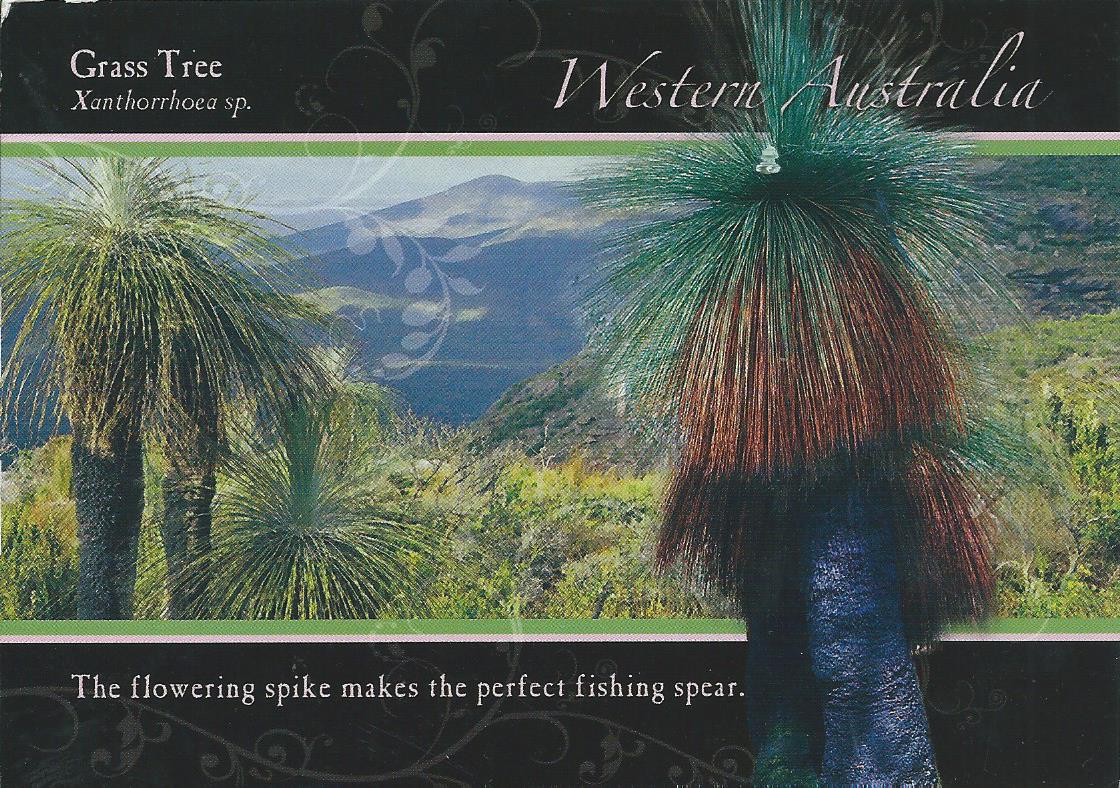
AUSTRALIA ~ Grass Tree ~

... Great view of the grass tree... this unusual and iconic plant is native to West Australia... the Noongar name for grass trees is "Balga" and are important to the Aboriginals as a highly valued resource with many uses... they were a "staple" plant, providing food, drink, medicines, fibre and materials for making implements and weapons... the tough leaves were used as knives to cut meat... although protected in national parks, unfortunately the grass tree has been a victim of land clearing... to conserve them they are sometimes removed before an area is cleared and replanted elsewhere... Thanks a lot Cathy!【ツ】

The Balga is a perennial tree-like monocot (grass) that grows up to 5m high, with an often blackened trunk, to over 3m. Grass trees grow at a slow rate of just 2 cm each year. It can take over 20 years for Xanthorrhoea to grow a trunk, and it takes years for them to reach full size.

Balgas are found on grey to black sands, grey-brown loam, brown gravelly sandy clay, laterite, granite. Their range includes the coastal plain and near watercourses. Closely packed whitecream flowers are found on a 1.5-2.5m spike in June or August to December. Balga are often stimulated to flower by fire burning the plant.


Stamp:

Australian Native Wildlife 
(Issued 06-03-2006)

Monday, June 20, 2022

AUSTRALIA ~ Karlu Karlu / Devils Marbles Conservation Reserve ~

... An awesome nature attraction and one of the Northern Territory’s most impressive geological wonders... these gigantic granite boulders come in various shapes and sizes... some of them are up to seven meters in diameter and many of them are precariously balanced on top of one another... an impressive desert landscape stretching as far as the eye can see in the midst of the Australian Outback... the Devils Marbles or "Karlu Karlu" are a sacred site for the local Aboriginal people... they are culturally and spiritually significant to them... an Ancient Aboriginal Meeting Point... it was only in 2008 that this amazing natural site was given back to the site’s traditional owners and now Devils Marbles are managed by them... Thanks a lot Denny for this lovely surprise! (✿ ♥‿♥)

Photograph: Katacarix/Shutterstock.com

Karlu / Devils Marbles Conservation Reserve is a protected area in the Northern Territory of Australia located in the locality of Warumungu.The Devils Marbles Conservation Reserve is 1802 hectares in size.

Formed over millions of years these rocks continue to crack and move with time and mother nature. Erosion has played a significant part in developing this landscape. Over time, the blocks of granite have developed horizontal and vertical cracks. Wind and rain over millions of years have eroded into the magnificent boulders that you see today. 

The term Devils Marbles came from John Ross, a Scottish-Australian explorer who led a team surveying the area for the Overland Telegraph Line in 1870. He said: “This is the devil’s country; he’s even emptied his bag of marbles around the place.”

 
Prestamped postcard

Friday, October 8, 2021

AUSTRALIA ~ Cascades Female Factory - Tasmania - UNESCO ~

... Nice litho showing a fascinating but horrifying look at Tasmanian history... the humble remains of one of the few female convict factories are nestled in the hills of Hobart surrounded by history and gum trees... a beautiful setting where terrible cruelties were committed... it gives an excellent view into the mid 1830’s when women prisoners were kept in working conditions... it is amazing how the women and their children survived in these conditions when sent by boat then jailed here... often for very petty crimes committed in England... so many sad stories... convicts were a source of labour to build roads, bridges, courthouses, hospitals and other public buildings, or to work on government farms, while educated convicts may have been given jobs such as record-keeping for the government administration... a must-go experience immersed in social history... Thanks a lot Rod! ❀◕ ‿ ◕❀

"Detail of a lithograph by John Skinner Prout"

Built in 1828 and operating until 1856, the Cascades Female Factory became one of Tasmania's longest running penal institutions.The Cascades was established as a workhouse for female convicts. Intended to segregate women for their own protection and moral improvement, at its peak the factory held 1,200 women and children in overcrowded and disease-ridden conditions, with women labouring up to 12 hours per day.  

These convict sites present the best surviving examples worldwide of large-scale convict transportation and the colonial expansion of European powers through the presence and labour of convicts.

Cascades Female Factory Historic Site is listed as one of the 11 sites that together form the Australian Convict Sites World Heritage Property, inscribed on the UNESCO list in 2010.


Stamp:

Prepaid maxicard
(Issued 20-10-2020)


Thursday, September 16, 2021

AUSTRALIA ~ Baudissin Glacier edge - Heard Island - UNESCO ~

... Fantastic postcard of one of the most isolated islands on our planet... and one of the most rare pristine island ecosystems... with a complete absence of alien plants and animals, as well as human impact... it is very dangerous and almost impossible to reach it... you have to pass through some of the roughest seas on the planet to get there... for those reasons, there are currently no commercial tour operations that visit Heard Island... no-one lives permanently on the island and there is no Post Office, so unfortunately it's not possible to receive a postcard directly from Heard Island... anyone wishing to visit the islands must first obtain a permit from the Australian Antarctic Division... the shallow and fast flowing glaciers on Heard Island respond quickly to rising temperatures, which make them important for monitoring climate change... Thanks a lot Rod for this wonderful surprise... so nice to hear from you after such a long time! (✿ ♥‿♥) 

Photo Matt Curnock

Heard Island is a subantarctic island located in the Southern Ocean, about 4,000 km south west of mainland Australia. The island have been an Australian territory since 1947 and contain the country's only two active volcanoes, it's highest mountain, and it's only glaciers. It is part of the Australian external territory of Heard Island and McDonald Islands. The islands and surrounding waters offer a unique opportunity for conducting scientific research.

Heard Island is the largest island, 2,368  km2. It is an active volcano covered with glaciers. The islands were discovered in the mid-1850s. An American sailor, John Heard, reported seeing the larger island in 1853 and promptly named it after himself. 

Baudissin Glacier is a tidewater glacier on the north side of Heard Island. in the southern Indian Ocean. Located 1.9 km west of Challenger Glacier, Baudissin Glacier is 2.8 km wide and flows into the western part of Corinthian Bay.

 
Prestamped postcard

Tuesday, January 12, 2021

AUSTRALIA ~ Budj Bim Cultural Landscape - National Park - UNESCO ~

... A fascinating new UNESCO site... a place with over 32,000 years of history... Budj Bim is one of the most extensive and oldest aquaculture systems in the world...  it’s also the site of over 100 permanent stone dwellings... for thousands of years, dwellings such as these were home to a settled community of Gunditjmara people... as well as its cultural significance, the area is beautiful, with great crater lake views... it’s perfect for picnics, camping, bushwalk and mountain biking... nature trails follow the old crater rim.... Budj Bim is a must-visit natural wonder... Thanks Helen!【ツ】 


The Budj Bim National Park, formerly known as Mount Eccles National Park, is a national park located in Victoria with an area of  5,470 hectare.The park now forms part of the larger Budj Bim heritage areas.  It derives its name from Budj Bim, formerly Mount Eccles, which is situated in the north-east of the park.

The Dhauwurd Wurrung, also known as the Gunditjmara  are the traditional owners of the areas now encompassing Warrnambool, Port Fairy, Woolsthorpe and Portland. Their land includes much of the Budj Bim heritage areas.

The way of life of the Aboriginal people of Western Victoria differed from other Aboriginal Victorians in several respects. Because of the colder climate, they made, wore, and used as blankets, rugs of possum and kangaroo. They also built huts from wood and local basalt (known as bluestone), with roofs made of turf and branches.

In June 2019, Budj Bim became the first Australian site to be included on the UNESCO World Heritage List solely for its Aboriginal cultural values.


Stamp: 

Postage Paid

Wednesday, December 5, 2018

AUSTRALIA ~Elephant Rocks - William Bay National Park~

... Great new Australian National Park for my collection👍... a wonderful view of a natural phenomenon... huge granite boulders and spectacular rock formations... as it name suggests, Elephant Rocks looks really like a herd of elephants gathered in a group, paddling in the shallow waters... the most visited places within William Bay National Park... the Rainbow Coast has some of the most spectacular coastline... endless stretches of white sandy beaches, turquoise waters, wilderness peaks and ancient forests makes it one of the most pristine places on earth... Thanks a lot Denny!!❁◕ ‿ ◕❁
William Bay National Park is located in the Great Southern Region of Western Australia along the Rainbow Coast, and is in the Shire of Denmark. It covers an area of 1734 hectares and includes Greens Pool and Elephant Rocks.

William Bay was named after the famed British Arctic explorer and navigator, Sir William Edward Parry, as were two other nearby features, Parry Inlet and Edward Point.


Stamp:

 Postage Paid