Showing posts with label Mexico. Show all posts

Friday, April 17, 2026

MEXICO ~ Querétaro - UNESCO ~

... Lovely evening view of the historic centre of this colonial city..."La Casa de la Corregidora" is famous for hosting some of the most important meetings leading up to Mexico’s declaration of independence against Spain... this public square opened in 1910, features a prominent statue of Josefa Ortiz de Domínguez ("La Corregidora") and a plaque commemorating her key role in the Mexican Independence movement... it acts as a focal point for history-themed tourism... the charming city of Querétaro is recognized for its Spanish colonial architecture, well-preserved Baroque buildings and pink stone aqueduct... it's a key spot for local culture... Thanks Alonso! ¯\_(ツ)_/¯  
Photo: Carlos A. Estrada

Querétaro is the capital and largest city of the state of Querétaro, located in central Mexico. Originally Otomí territory, it was incorporated into the Aztec empire in 1446 before Spanish control was established in 1531.

In 1996, the historic center of Querétaro was declared a World Heritage Site by UNESCO.

 Stamps:

Mexico Brand 
(Issued 13-11-2018)

National School of Notaries, 70 Years
(Issued 27-11-2025)

Monday, March 16, 2026

MEXICO ~Oaxaca Churches - UNESCO ~

... Nice views of a picturesque city full with many colonial-era buildings and significant archeological sites... the Basilica of Our Lady of Solitude, the Santo Domingo church and former convent are all excellent examples of Oaxacan religious architecture from the colonial period, but Santo Domingo de Guzmán is the most outstanding and one of the landmarks of the city... considered by many to be one of the finest examples of Dominican architecture in Mexico and built on a grand scale... the formerly monastery grounds of the Church is now home to the Museo de las Culturas de Oaxaca and displays a wide variety of cultural artefacts and offers visitors a glimpse into the region’s rich history and culture... Thanks Alonso!【ツ】

Oaxaca de Juárez, or as it’s commonly referred to as Oaxaca, is the capital and the biggest city of the state of Oaxaca, which is in the Southwestern Mexico, nestled in a fertile valley at 1,550 meters above sea level.

The city, together with the nearby archeological site of Monte Albán, was designated in 1987 as a UNESCO World Heritage Site.

Stamps: 

2X Definitives - Handicraft
(Issued 01-01-2020)

The 50th Anniversary of the City of Cancún 
(Issued 03-03-2020)

Tuesday, May 20, 2025

MEXICO ~ Postal Palace - Mexico City ~

... Stunning interior view of a still working post office... a wonderful place for sending mail... always a great pleasure for a postcard collector to see where it was sent from👍... at the time it was built, this majestic colonial building served as the flagship of Mexico’s brand new mail service, and it was here that the very first Mexican stamp was ever issued... an Art Deco styling interior with "golden ornate" structural parts all around... most prominently is the "grand staircase" and "quite a breathtaking" ornate features on all the structures around the staircase to see straight upward from the bottom... not to be missed is the postal museum in one of the rooms with "classic stamps" and some old pieces of postal equipment on display... Thanks once more Diego! (✿◠‿◠)  P.S. I'm sorry but I can't send you a postcard in return because I'm struggling reading your handwriting🙄... not sure about your address or email...  

Palacio Postal often referred to as Correo Mayor had its first stone placed in 1902, though the building ultimately took five years to complete.

Despite regular earthquakes (including a major one in 1985 which caused damage requiring no small amount of restoration to the historic building), Palacio Postal has been in continuous operation since its opening day in 1907.
 

Stamps:

The 20th Anniversary of the Association of Latin American Integration 
(Issued 11-08-2000)

2X Textile Art 
(Issued 13-10-2023)

Definitives - Handicrafts 
(Issued 01 - 2014)

Wednesday, December 18, 2024

MEXICO ~ Torreon - Coahuila ~

... Lovely views of a city full of history, culture, and natural beauty... the Jewel of Northern Mexico... known for its significant role in the Mexican Revolution... a vibrant city that offers a unique blend of tradition and modernity... cowboy land with ranches, vast deserts and the most beautiful sunsets... with a great selection of lovely stamps👍... Thanks a lot Diego!(✿◠‿◠)  It's always a pleasure to see your postcard friends hometown😊...

"The Christopher Columbus Monument - Nazas Theatre - Nazas Bridge"

Torreón is located in southwestern Coahuila state, northeastern Mexico. It lies along the Nazas River at an elevation of 1,120 meters. It is is one of northern Mexico's main centers for manufacturing, services, and commercial agriculture.
 

Stamps:

The 65th Anniversary of Federal Justice Tribunal 
(Issued 23-09-2001)

2X Textile Art 
(Issued 13-10-2023)


Wednesday, September 18, 2024

MEXICO ~ Peña de Bernal monolith - Bernal ~

... Great view of the iconic and main attraction of the town, the Peña de Bernal massive monolith... it rises  433 meters and creates a staggering backdrop of the town... it is the third-tallest monolith in the world.... you can hike up 80% of the rock to an ample outlook point... it is an incredibly steep hike at an altitude of 2500 meter above sea level... with spectacular view of the town, sky, and surrounding mountains...  at the highest point there is a small chapel where many religious travelers like to leave offerings or pray to culminate the climb... located in the heart of Mexico, Peña de Bernal is a charming and picturesque pueblo mágico (magical town)...it has very colorful cobbled streets, architectural and artistic buildings... Thanks a lot Carlos!【ツ】


San Sebastián Bernal, better known as Bernal (Spanish: from Basque Vernal, "place of stones or boulders"), is a colonial village in the Mexican state of Querétaro. It was founded in 1642 by Spanish soldier Alonso Cabrera.

According to geologists, Peña was formed as the relic of a volcanic eruption from the Jurassic Period. The lava from the volcano's center is harder than the surrounding crater. Over the millennia, the softer rock eroded away, leaving us with the hardened lava.  

Translated from the Greek word “monolithos”, monolith means single stone. 


Photo: Carlos A. Estrada


Stamp:

Textile Art
(Issued 13-10-2023)

Monday, July 1, 2024

MEXICO ~ Cathedral Morelia - UNESCO ~

... Impressive view of the Baroque Morelia Cathedral right in the Historic Center... it dominates the city skyline with two 70 meters towering bell towers... it took over a century to build, starting in 1640 with the style of architecture that was popular at that time and ending in 1744 with a “more modern” style of architecture popular 100 years later... using the local pink limestone called cantera... one of the highlights in the cathedral is the huge organ with 4,600 pipes, the second biggest organ in Mexico... Morelia Cathedral looks especially beautiful when it’s all lit up at night... Thanks a lot Artoso! (•‿•)

Morelia is the capital of Michoacán and the biggest city in the state. 

Founded in 1541, and originally called Valladolid (after its namesake in Spain), it was renamed Morelia during the 19thC in honour of one its favourite revolutionary sons, José María Morelos. One of the cool things about Morelia is that it was built from the ground up by the Spanish colonists. However, it still has a huge indigenous and native influence due to the Purepecha and Tarasco people of Michoacan.

The entire city of Morelia was designated by UNESCO as a World Heritage Site in 1991.


 Stamps:

2X Textile Art 
(Issued 13-10-2023)

Ancient Temples - Joint Issue with Guatemala 
(Issued 19-09-2023)

Monday, June 17, 2024

MEXICO ~ Underground Tunnels - Guanajuato ~

... Nice view of a unique network of tunnels that forms an underground labyrinth... with car lanes, bus stops, side walks and lots of staircases leading up to ground level... originally built to contain a river that ran through the town... after the river was diverted, the dry riverbed was paved and used as a road... more tunnels were built and now there is a maze of routes under the city... the streets of Guanajuato are narrow, cobble stoned, and mostly traffic free - making the tunnels perfect for traffic... Thanks Yesi!【ツ】

Although Guanajuato's famous tunnels appear to be ancient, most are less than 100 years old. The oldest was constructed in 1905 along the dried-up Rio Guanajuato riverbed. 

Guanajuato is a large city in the central highlands of Mexico and was founded as a town in 1554 and received the designation as a city in 1741. It is located in one of the richest silver mining areas of Mexico, and is well known for its wealth of fine colonial-era Spanish architecture. The historic town and adjacent mines are designated as UNESCO World Heritage Site.

Stamps:

Day of the Dead 
(30-10-2019)

Combat Corona Campaign - Everyday Heroes - COVID-19 
(Issued 03-11-2020)

Wednesday, November 15, 2023

MEXICO ~ Pre-Hispanic Town of Uxmal - UNESCO

... Beautiful view of one of the most important archaeological Mayan sites... built on top of some hills in the middle of the forest... one of the most striking testimony of the Maya civilization and Mexico’s lesser known treasures... the number of monuments, their quality and the level of details featuring the Puuc architecture makes it spectacular... parts of the site are well preserved... but also a considerable amount of restoration has been done to parts of the site that were crumbling... a visit to the ancient Mayan site of Uxmal is definitely a must do of anyone interested in the history, culture and architecture of the Mayans... Thanks a lot Yesy!【ツ】  
The Pre-Hispanic Town of Uxmal comprises the remains of the Late Mayan centers of Uxmal, Kabah, Labná and Sayil.

Ceramic evidence points to an early occupation at Uxmal dating back to 800 BCE. The majority of the structures seen today date from the Late Classic (600-900 CE) and its architecture is termed Puuc style. 

"Puuc" is the name of the hilly region just below Merida where these sites are located. And it’s the name of the architectural style named after it. At these sites, cosmology was used to determine the urban layout and the characteristic Puuc architecture with richly decorated building facades was developed. Most show representations of the head of Chaac, the rain god.

This pre-Hispanic city was declared a World Heritage Site by UNESCO in 1996.


Stamp:

The 75th Anniversary of Autonomous University of Mexico State 
(Issued 17-10-2019)

Thursday, July 14, 2022

MEXICO ~Temple of Warriors - Chichen Itza - Yucatan - UNESCO ~

... View of the great statue of "Chac Mool" laying at the top of the Temple of the Warriors... part of the magnificent Chichen Itza archaeological site... depicting a reclining figure supporting itself on its elbows with a bowl or a disk upon its stomach... Chac Mools were considered messengers of the Gods and used to hold religious offerings in the upraised flat plate area on the figure’s stomach... some speculate this was where beating hearts of the sacrificial victims were placed as a spectacle for the crowds below in the plaza... this pre-Columbian city is a great testimony of Mayan civilization and its people's way of life several millenniums ago... Chichen Itza  became an important archaeological site in the 1800s, and attracts millions of tourists every year... Thanks a lot Rafal! ¯\_(ツ)_/¯

Photo: Ignacio Urquiza

The name Chichen Itza is a Mayan language term for "at the mouth of the well of the Itza". The Itza were an ethnic group of Mayans who had risen to power in the northern part of the Yucatan peninsula, where the city is located. The well in the name refers to a number of underground rivers that run beneath the region and likely served as the source of water for the city. This easy access to water made the location perfect for a city the size of Chichen Itza.

Chichen Itza was a significant center of political and economic activity in the Mayan culture by roughly 600 A.D.

Chichén Itzá was designated a UNESCO World Heritage site in 1988.


Stamps:

Central Post Office 
(Issued 17-02-2017)


Flag Day 
(Issued 24-02-2021)

Tuesday, June 21, 2022

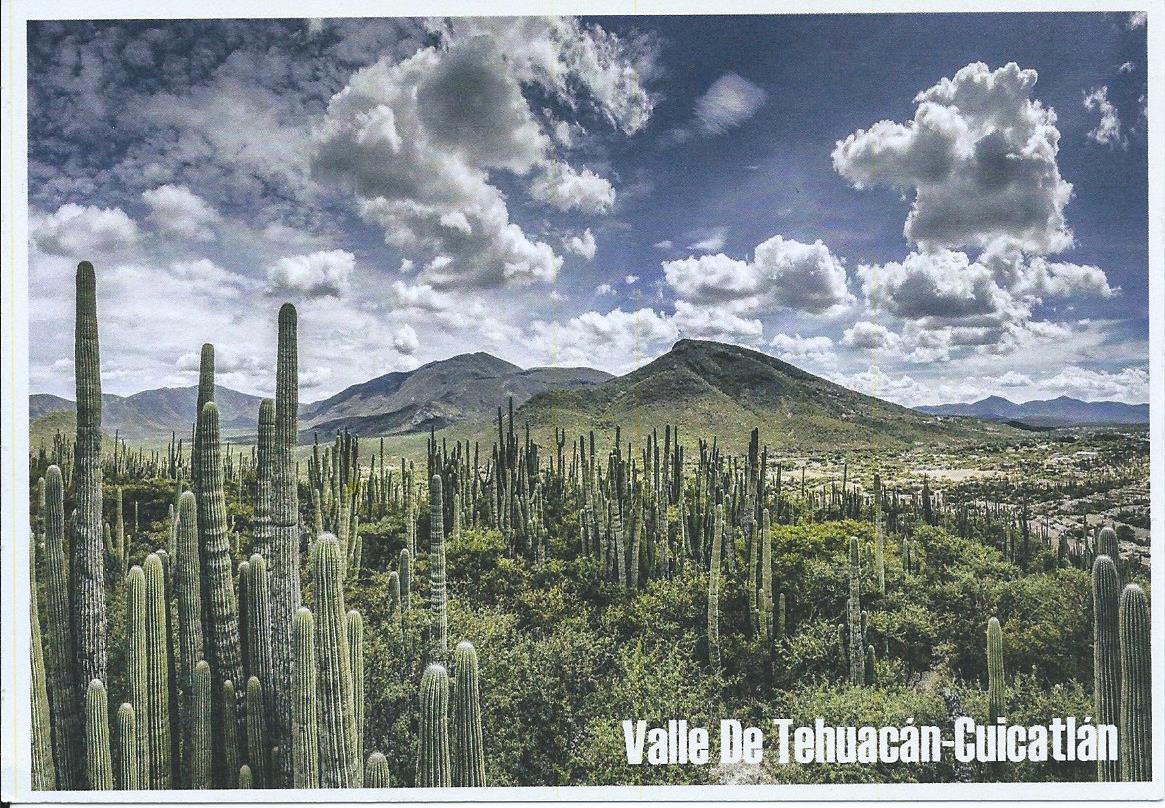
MEXICO ~ Tehuacán-Cuicatlán Valley - UNESCO ~

... Nice view of the Tehuacan-Cuicatlan Valley a beautiful landscape full of cacti🌵🌵🌵... an unprecedented 2,686 species of columnar cacti being found here... one of the last remaining areas of wild cactus species in such density in the world and a crucial site of evolution in "the Cactaceae family"... because so much of the cacti family are endangered, considering the rampant amount of succulents being sold commercially... apparently there are a lot of illegal operations in Mexico and around the world to harvest cacti for household and commercial landscape😔... botanically it is not only of special significance for its cacti, but also for agaves, yuccas, bromeliads, bursera, and oaks... the diverse fauna includes threatened amphibian and bird species... from a cultural perspective, this "mixed" site reveals archaeological evidence of human adaptation and development spanning more than 12,000 years... all activities are developed by small communities, genuinely concerned about preserving the area... Big Thanks once more Gabino! ✿◕ ‿ ◕✿

Tehuacán-Cuicatlán Biosphere Reserve is located in central Mexico in a valley landscape backed by mountains in Puebla and Oaxaca State, with around 500,000 hectares of protected land. 140,000 hectares of which is being considered for UNESCO World Heritage Status and the remainder as a buffer zone in which minimal human activities are permitted.

The Biosphere’s limits are defined by four mountain ranges; Sierra Mixteca, Sierra Zongolica, Sierra Mazateca, and Sierra de Juárez, which leads to the complex geography of separate valleys divided by mountains producing the tremendous biological and ecosystem diversity seen here across an altitudinal variation of 1500 – 3200 meters above sea-level.

On July 2, 2018, the site was listed as a UNESCO World Heritage site.


Stamps:

4X Definitives - Handicraft 

The 35th Anniversary of the First Mexican Astronaut and the 35th Anniversary of the Morelos II Satellite 
(Issued 17-12-2020)

Thursday, June 9, 2022

MEXICO ~ Whale Sanctuary - El Vizcaíno Biosphere Reserve - UNESCO ~

... Wonderful postcard for my whale collection and UNESCO site👍... the largest wildlife refuge in all of Latin America and certainly the most diverse... but what is most spectacular and gives this region uniqueness found nowhere else on this planet, is that it is the birthplace of the Pacific Gray Whale commonly known as the California Gray Whale... this reserve is the winter home of more than 12,000 grey whales... often you are surrounded by several of them at the same time, the chance to see mothers and calves together, the fact that the whales aren’t just passing by but actually are living (mating, breeding) in the area, how close you get to them, the low-key approach of the whale watching tourism (small boats, and they leave each other alone and do not crowd around sightings) makes this an amazing place to visit💙... also home to exquisite populations of sea turtles, Baja California pronghorn, and unique flora across a rich landscape... Big Thanks Gabino! (✿◠‿◠)

El Vizcaino is located in the central part of the Baja California peninsula in the Sebastian Volcano region, between the Gulf of California and the Pacific Ocean. El Vizcaino has a landmass of over 2.5 million hectares. There are also10,000 year old cave paintings and Petroglyphs, 17thC missions and it is the least populated region in Mexico: less than one person per 2km.

The Whale Sanctuary of El Vizcaíno comprises two coastal lagoons, Laguna Ojo de Liebre and Laguna San Ignacio, and their surroundings.

Declared a national biosphere in 1988 and inscribed on the World Heritage List in 1993.

Stamp:

The 200th Anniversary of Diplomatic Relations with Colombia
(Issued 20-11-2021)

Tuesday, March 15, 2022

MEXICO ~ Camécuaro Lake - Michoacán ~

... Fantastic new National Park postcard💚... lying in the Lago de Camécuaro National Park, Lake Camecuaro is small but packed with natural beauty... this spectacular lake has tall and old cypress trees (Ahuehuete tree)  around it as well as in it, which are truly incredible to see from its roots up... it is spring-fed, so you’ll see crystal clear blue and green waters... even though the lake is relatively small, many photographers from all over Mexico come to take professional photographs that capture the parks picturesque views... a little piece of paradise and a hidden gem for locals and tourists... Thanks a lot Gabino! (✿ ♥‿♥)

Lago de Camécuaro National Park is located east of the city of Zamora de Hidalgo in the municipality of Tangancícuaro in the state of Michoacán. The Park consists of 9.65 hectares of protected area including Camécuaro Lake which is supplied by a series of natural springs.

Camécuaro derives from the native language purépecha or tarasca which means "Place of Bathing"

Lake Camecurao was declared a national park by President Lázaro Cárdenas del Río in 1940 in efforts to conserve the flora and fauna found there. The presidential decree was later signed into law in 1941.

Stamp: 

The 200th Anniversary of the Complete Independence of Mexico  
(Issued 09-08-2021)

Thursday, November 14, 2019

MEXICO ~ Hospicio Cabañas - Guadalajara - UNESCO ~

... Great view of one of Guadalajara’s architectural landmarks... built in the form of an enormous square with single store buildings which consists of masses of hidden arched courtyards.., together with 2 large domed chapels... it was one of the oldest and largest hospital complexes in South America... provided care for around 6,000 people during its lifetime as a hospital... its original purpose was as an orphanage and home for invalids,  the elderly and the sick ... unique for its time... the hospital finally shut down in 1980 and today the building houses the Cabañas Cultural Institute, an arts and crafts school... highlight of the interior decoration is a series of 57 monumental frescoes which are regarded as masterpieces of Mexican art... Thanks a lot Gabino!【ツ】
The complex was founded in 1791 by the Bishop of Guadalajara in order to combine the functions of a workhouse, hospital, orphanage, and almshouse. It owes its name to Juan Ruiz de Cabañas who was appointed to the see of Guadalajara in 1796 and engaged Manuel Tolsá, a renowned architect from Mexico City, to design the structure. Following the death of Cabañas in 1823, construction lasted until 1829.

 Hospicio Cabaña was made a Unesco World Heritage site in 1997.


Stamps:

Handicrafts
(Issued 01-01-2018)

Butterflies
(Issued ????)

Friday, May 11, 2018

MEXICO ~ Pyramid of the Sun - Teotihuacan - UNESCO ~

... Beautiful view of the largest pyramid at Teotihuacán and the third largest pyramid in the world (after the Great Pyramid Cholula also in Mexico and the Great Pyramid of Giza in Egypt)... a huge UNESCO site with a 2,000 year-old history... probably used as a religious and sacrificial center...  the Pyramid of the Sun consists of over 3 million tons of stone... built enterily without any metal tools or help from animals... thousands of visitors a month climb the 248 steps up the Pyramid... Thanks a lot Marco!!ヽ(ヅ)ノ
Built between 100 and 200 AD, the structure was originally 215 by 215 m at the base, and about 63 m high. The Pyramid was rebuilt fifty to seventy five years later and enlarged to a final 225 m square and 75 meters high to become one of the largest buildings created in the Pre-Columbian New World. The temple that once crowned the Pyramid was completed in 300 AD.

The pyramid was built with 4 stepped platforms made with stone blocks plastered with lime plaster and painted red and other brilliant colors with murals and motifs. When the site was rediscovered early in the 20thC, the pyramids appeared as hills of stone rubble with trees and plants growing up from the rocks. The temple atop the Pyramid of the Sun had long vanished from the towering structure.

It is part of Pre-Hispanic City of Teotihuacan and became a UNESCO WHS in 1987.

Stamp:

International Year of Crystallography
19-11-2014)

Tuesday, March 6, 2018

MEXICO ~ El Castillo - Tulum National Park - UNESCO ~

... Fantastic new National Park and my first from Mexico... the legendary Tulum ruins are one of the most well-known archeology sites and one of the most visited in Mexico... over two million people visit Tulum each year ʘ͜͡ʘ... crowded or not, it's worth the visit.... a magnificent archaeological site in greenery surrounded by sandy beaches with turquoise blue water...  renowned as being one of the old Mayan sites along the ocean with stunning cliff side views of the Caribbean Sea...Thanks a lot Alonso!! ✿◕ ‿ ◕✿
Photo: Luis Gomez C.

Tulum  is one of the very few walled cities known to be built by the Maya. It is located in the southeast of Mexico on the coast of the Caribbean Sea on 12m tall cliffs and was one of the last cities built and inhabited by the Maya. It was at its height between the 13th and 15th centuries and managed to survive about 70 years after the Spanish began occupying Mexico. Old World diseases brought by the Spanish settlers appear to have resulted in very high fatalities. They disrupted society and eventually caused the city to be abandoned.

It was surrounded by huge walls as their protection with having just five entrances. But it was assumed that only the governors and priests lived within the walled city while most people lived outside the walls.

The tallest building next to the Temple is the " El Castillo". Some referred it as the lighthouse during the Mayan settlement era, while others considered it as the city landmark for the sailors coming from the Pacific, Gulf and other parts of Central America.

Sian Ka’an is a natural UNESCO World Heritage Site in Mexico that was inscribed in 1987.

Stamps:

Handicrafts
(Issued 30-11-2005)

The 80th Anniversary of the IPN
(Issued 20-05-2016)


Monday, February 26, 2018

MEXICO ~ The Arch - Los Cabos ~

...Yeaaaaah!!! Crossing my fingers helpedツ... your fantastic postcard arrived finally after two months traveling... and it was worth the wait... what a breathtaking view... it must have been the perfect winter escape... Baja Los Cabos is a unique mixture of miles of amazing beaches with sparkling sapphire blue waters... next to deserts and the most unique rock formations and landscapes...  the Arch of Cabo San Lucas is one of the most famous landmarks... situated at the tip of the world  "Land's End"... National Geographic magazine has named Los Cabos one of the must-see places to visit in 2017...  a real paradise between two seas...  where the Gulf of California meets the Pacific Ocean... Thanks soooooo much Andrene!! ( ˘ ³˘)❤
Photo: A & P. Giberstein

Los Cabos  is located at the southern tip of Mexico's Baja California Peninsula, in the state of Baja California Sur. It encompasses the two towns of Cabo San Lucas and San José del Cabo (the municipal seat) linked by a twenty-mile Resort Corridor of beach-front properties and championship golf courses.The area was remote and rural until the latter 20thC, when the Mexican government began to develop Cabo San Lucas for tourism, which then spread east to the municipal seat. Tourism is by far the main economic activity with over two million visitors per year.

El Arco and the Arch refer to the arch-shaped rock formation that makes up a part of the larger Land's End rock formation, also known as El Finisterra and is located at the southern tip of Cabo San Lucas, which is itself the extreme southern end of Mexico's Baja California Peninsula. The arch is locally known as El Arco.


Stamps:

2X World Food Day
(Issued 24-11-2014)

Friday, January 5, 2018

MEXICO ~ San Juan de Dios Market - Guadalajara ~

... Delicious fruits and vegetables displayed for sale... this is probably the biggest and oldest market under a roof in Latin America... it gives travelers a unique shopping experience... three levels market that appears to be one of Guadalajara's hot spots.... it literally sells everything and anything you can think of... each level has sections for something specific... from traditional clothing, jewelry, food, fresh meat, candy, tequila to touristy items... Thanks a lot Diego!!【ツ】
Mercado San Juan de Dios (San Juan de Dios Market) is located in the city of Guadalajara, Jalisco,  in the Historical District of the city. The market was inaugurated on December 30, 1958 and was designed by the architect Alejandro Zohn. There are approximately 3.000 posts in the market with an area of 40,000 m².

Guadalajara is Mexico’s second largest city and the capital of Jalisco, home of tequila, mariachi and charreria, the country’s official national sport. It is a city steeped in tradition but also one of the country’s most vibrant and a cosmopolitan.

Stamps:

The 150th Anniversary of the Restoration of the Republic
(Issued 14-07-2017)

The 4th Anniversary of the Telecommunications and Broadcasting Reform
(Issued 26-06-2017)

Thursday, August 17, 2017

MEXICO ~ Tequila Town - Jalisco - UNESCO ~

... Beautiful unique view of a field blue agave... the plant that gets you drunk off tequila... never knew that is not just a drink but also a place... this area produce the entire world supply of tequila, some 60 million gallons each year... Jalisco’s diversity, beautiful landscapes and cultural traditions make it one of Mexico’s most popular tourist destinations.... Thanks a  lot Alonso!!ヽ(ヅ)ノ

"An agave field and a traditional factory compose this image"

The famous "Tequila" liquor, done with the juice of the Blue agave, takes its name fro the town Tequila Jalisco. This region, which besides the state of Jalisco also includes parts of the Mexican states of Guanajuato, Michoacan, Nayarit and Tamaulipas.

Tequila made outside these regions is forbidden, by law, to be labeled tequila.

The area encompasses 85,650-acres of land between the Tequila volcano and the Rio Grande River. This region contains a living, working landscape of agave fields, including distilleries, factories and haciendas.

It was declared a World Heritage Site by UNESCO in 2006 due to its unique features of natural landscape and cultural traditions.

Stamps:
2017 Mexico Aerospace Fair
(Issued 26-04-2017)

April World Intellectual Property Day – Innovation, Improving Lives
(Issued 26-04-2017)

Thursday, September 22, 2016

MEXICO ~Historic Centre of Mexico city-UNESCO~

...Great postcard showing four examples of different architectural styles of the historical centre of Mexico city... a must see in the city... and most of them beautifully preserved...Thanks a lot Marco!! ツ
Palace of Fine Arts      National Palace      Palace de Correos      Metropolitan Cathedral

Mexico city, one of the largest cities in the world, was founded above the prehispanic city of México, Tenochtitlan in the year 1325 by the Aztecs and was conquered by the Spaniards in 1521.

The Historical Centre is the oldest part of Mexico City and it’s also the area that contains some of the most appreciated cultural treasures of the country.

It was recognized as Heritage City in 1987 due to its Historic Center and its Xochimilco National Park.

Stamp:

Handicrafts
(Issued 30-10-2005)

Monday, February 8, 2016

MEXICO ~ Coyoacán market ~

...Wonderful market postcard...an abundance of colorful and tasty looking tropical fruit... most of them are new to me.... Many Thanks Eddy also for the great stamps!


Coyoacán (place of the coyotes) remained completely independent of Mexico City during the colonial period until the mid nineteenth century.

With its narrow, cobbled streets, colonial churches, vibrant markets, world-class museums and sidewalk cafes, its historic center is a popular destination for residents and tourists.


Stamps:

The 75th Anniversary of the Institute of Epidemiological Diagnosis & Reference
(Issued 17-10-2014)

National Football Team
(Issued 27-05-2014)